The colors swirled like a storm on the canvas. Amanda dipped her brush into a pot of deep blue, the color of a midnight sky before a big storm. She stood back, looking at the painting. It was a mess of jagged lines and angry colors. It showed what she felt inside. A knot, tight and painful, was always in her chest.
Amanda lived in a small, cozy apartment in a part of town called Ravenwood. The streets were usually quiet, but today, the sounds of the city drifted up to her open window. Car horns, distant shouts, the rumble of a delivery truck – it all mixed together into a kind of urban lullaby. Even though the sounds were noisy, it was better than silence. Silence made her thoughts echo too loudly.
Amanda was an artist. But not the kind who painted pretty flowers or happy faces. She painted what she felt. And what she felt was often heavy and dark. The paint on her canvas was a way for the darkness to come out, so it didn’t stay stuck inside her.
She glanced at the paintings stacked against the wall. Each one held a piece of her past. A past she didn’t want to remember, but somehow couldn’t forget. There was the one with the harsh reds and blacks, a memory of a shouting match that felt like it had torn the world in two. Then there was a painting of swirling greys, the color of confusion and fear that wrapped her after the loud fights. There were lighter ones too, but even those were touched by a hint of shadow.
A gentle knock on the door pulled her from her thoughts. It was her friend, Rose. “Hey, Amanda!” Rose called out, her voice bright and cheerful as sunshine. “You ready for the art show at the Midtown Heights gallery? I bet everyone will be amazed by your new painting!”
Amanda opened the door and a burst of sweet scent of lavender entered the room. Rose had a small bunch of lavender in her hand. “Hey, Rose,” Amanda managed a small smile. “I’m not sure about the ‘amazed’ part, but yeah, I guess I’m ready.”
Rose stepped inside, her eyes sparkling with excitement. “Come on, stop worrying so much! Your art is amazing, you know that?” Rose said. “Everyone needs to see how your brush can show feelings.”
Amanda shrugged, her gaze falling on her latest creation again. “I don’t know about feelings, Rose. Sometimes, I think I just paint the mess.”
Rose stepped closer, her smile softening. “But that mess, Amanda, it’s powerful. It’s like you’re taking something hard and making it beautiful.” She gently took Amanda’s hand, “Come on! Let’s get some lunch before the show.”
They walked down Ashbridge Avenue together, the sun warm on their faces. The shops were bustling with people. Amanda didn’t really hear the chatter, or the music playing in the shops. She was lost in her own thoughts again, her mind replaying the events that had shaped her art.
She remembered the fights that would shake the house like an earthquake. Every yell was like a sharp sting. And then the silence that came after, which was somehow even worse. It was the kind of silence that made your heart pound like a drum.
She remembered the fear, always there, lurking in the corners of her room, under her bed, in her nightmares. She remembered feeling so small and helpless, like a tiny boat tossed in a huge storm. She had carried those feelings with her, like a heavy backpack that she could never take off. She didn’t want to forget, and maybe, she shouldn’t. She realized art was her way of showing the feelings.
At lunch, Rose babbled about her recent trip to the beach at Harbourstead and about the new bakery that opened at Canyonview . Amanda tried to listen, but her mind was somewhere else. She saw the deep blue in her painting. She saw the angry reds and blacks. It was hard to get out of her own head sometimes.
“You okay, Amanda?” Rose asked, concern in her voice. “You seem far away.”
Amanda sighed. “Yeah, I’m just thinking about the show,” she lied.
“You know, everyone feels sad and scared sometimes,” Rose said gently. “You’re not alone.”
Amanda nodded, knowing Rose was right. She just wished it was easier to believe.
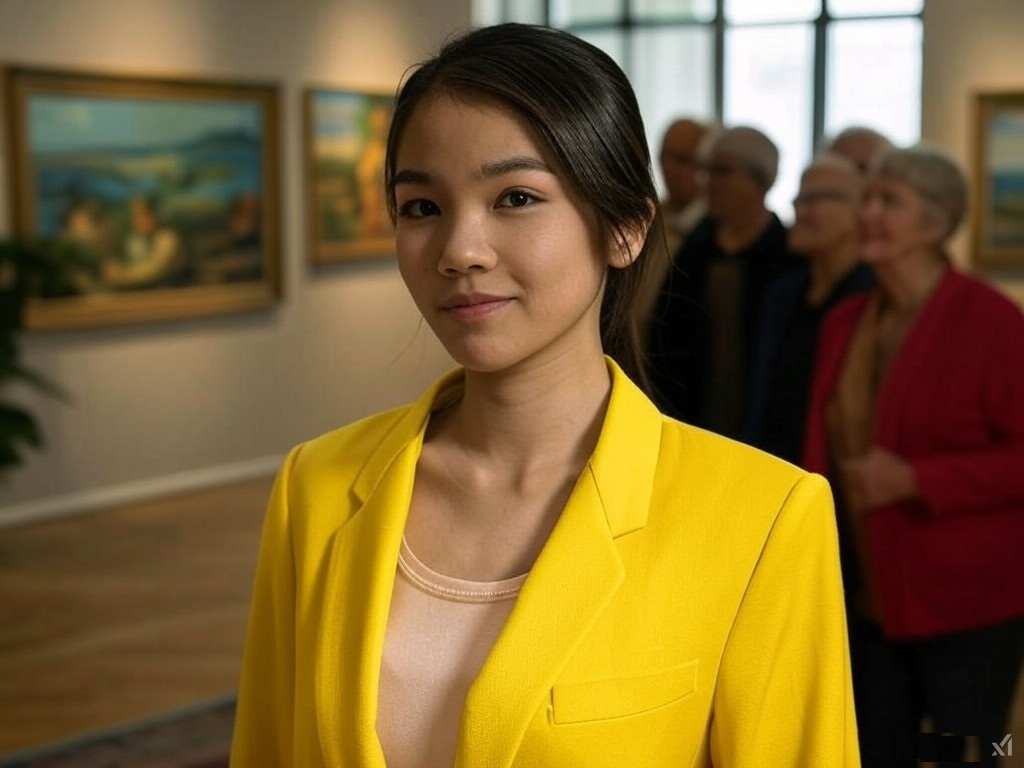
The art gallery at Midtown Heights was buzzing with activity. People milled around, sipping wine, looking at the art pieces hanging on the walls. Amanda felt a lump in her throat as she saw her paintings, hanging in their frames. They felt so exposed.
She saw a group of people standing in front of her painting. They were whispering. Amanda could not hear exactly what they were saying, but she could see their faces. There were all kinds of expressions: confused, thoughtful, maybe even a little sad. It was overwhelming.
“There you are!” A voice boomed from the crowd, and Amanda saw a tall man with a kind smile, making his way towards them. It was Mr. Ambrose, the owner of the gallery. “Your paintings are causing quite a stir, Amanda,” he said, clapping her on the shoulder. “People are talking about the depth of emotion in your work!”
Amanda felt her face turn warm. She was not used to this kind of attention.
“They are so powerful,” Mr. Ambrose said. “They speak to something so raw. It’s the kind of work that stays with you long after you’ve seen it. Do you know where this inspiration came from?”
Amanda didn’t answer right away. She looked down at her feet, then back at her painting. She was used to keeping her feelings a secret, hidden behind the strokes of her brush. But something about the way Mr. Ambrose looked at her made her feel safe.
“They come from my memories,” she said softly. “From things that hurt. From times when I was scared.” She spoke about the fighting, the fear, the silence, and how her art was the only way she knew to deal with it.
Mr. Ambrose listened intently, his eyes full of understanding. “Your work is a way to show a voice, Amanda. You are telling your story through your canvas.”
Amanda thought about his words as the evening wore on. She saw more people look at her paintings, their faces showing different emotions. Some looked thoughtful, some curious. Some even looked like they understood. Maybe they knew a little bit about the storms she had weathered.
Later, as the show was winding down, a young woman with long, dark hair approached Amanda. Her name was Elena, she said, and she was a writer. “Your paintings,” Elena said, her voice quiet, “they feel… like a voice. Like they are telling a story. I feel as if I understand it, even without words. Can I write about them?”
Amanda’s chest felt lighter at Elena’s words. It was as if someone had finally seen the message in her art, the feelings she had kept locked away.
“Yes, you can,” Amanda said, a genuine smile spreading across her face. It was the first true smile she had felt in a long time.
That night, after the show, Amanda walked home under the soft glow of the streetlights. The city sounds seemed quieter, less harsh. She thought about her paintings. She realized they were not just about her pain. They were also about her strength. She had taken her pain and turned it into something powerful, something that other people could connect with.
She climbed the stairs to her apartment, a new feeling bubbling up inside her. It was not joy, but it was close. Maybe it was hope.
She looked at the empty canvases waiting in her room. A tiny smile touched her lips. She didn’t know what she would paint next, but she knew she would keep painting. She knew she would keep letting her feelings out, one brush stroke at a time. The colors swirled in her mind, not like a storm, but like a quiet, peaceful sky after the rain.
Amanda picked up her brushes, her hand hovering over a blank canvas, ready to begin anew.
About the Author