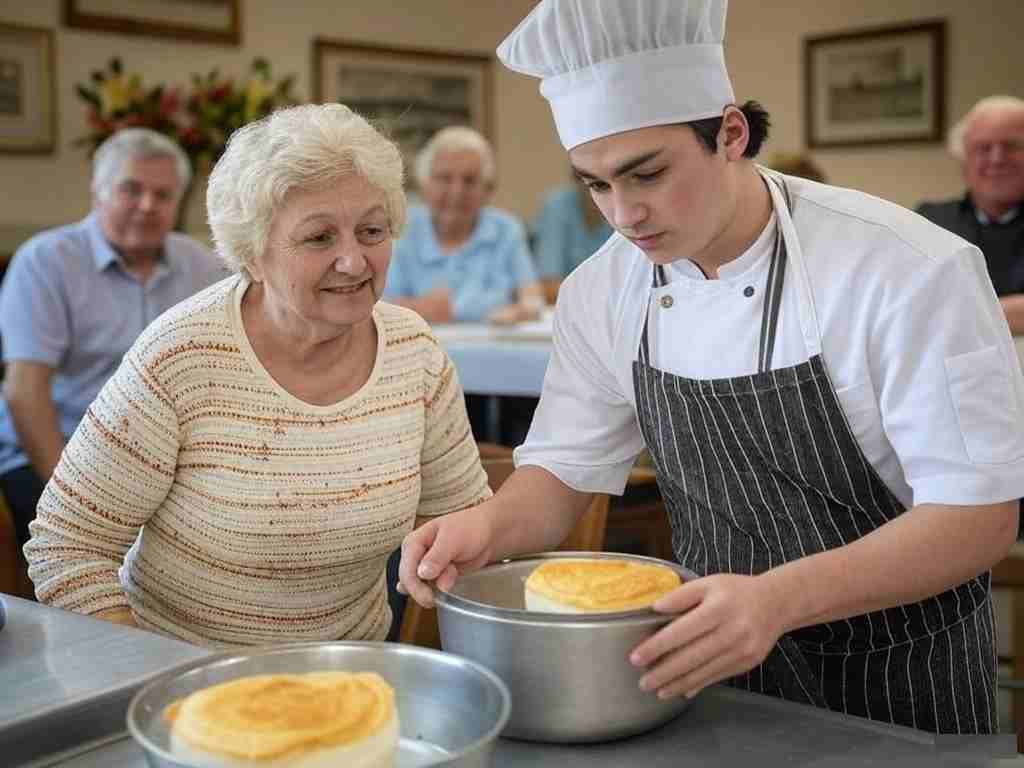
Agnes Butterworth was a woman of many talents. She could gossip like no other, recalling the most obscure details from decades ago as if they were yesterday’s news. She had a sixth sense for uncovering secrets, though how she managed this feat at the ripe age of eighty-five was a mystery to everyone, especially her great-nephew, Thomas.
Thomas, a 32-year-old office worker, found himself in constant awe of his Aunt Agnes, not just because of her sharp memory and uncanny ability to locate the best gossip, but because she also had a rather unique talent: she was always wrong about him. This time, however, she had outdone herself.
One sunny Tuesday afternoon, Thomas received a phone call while he was on his lunch break, eating a dry sandwich at his cubicle. It was Agnes, of course.
“Thomas! I just heard the most marvelous thing,” she began, her voice thick with excitement. “I always knew you had it in you!”
“Uh-oh. What’s this about now?” Thomas muttered under his breath. He had learned not to be surprised by her sudden outbursts. He’d been hearing her “revelations” since he was a child.
“You’re a chef! I knew it! I always said you were too fancy to just work in an office.”
“A chef?” Thomas nearly choked on his sandwich. “No, Aunt Agnes. I’m not a chef. I’m just a regular office guy. You know, spreadsheets, meetings, emails—boring stuff.”
“Nonsense!” she scoffed. “Don’t try to deny it. I’ve seen the signs. Your cooking skills, the way you handle a knife, the fine way you arrange those sausages when you’re making your famous ‘Tuesday night casserole.’ It’s all been so obvious to me. Everyone here in the retirement community is buzzing about it, too.”
Thomas glanced around his office, feeling a wave of panic. “Agnes, I’m not a chef! I’m telling you, it’s just toast and leftovers over here!”
But Agnes was having none of it. “Don’t be modest, Thomas. You’re practically famous around here now. The ladies at the knitting club are all talking about your culinary masterpieces. And I’ve already told them you’ll be making a special appearance at our annual potluck this Saturday.”
“Wait, what? No, no, no, Agnes, I—”
Before Thomas could finish his sentence, Agnes had already hung up. He stared at his phone, dread creeping up his spine. This was not good. Not good at all.
Saturday arrived with the kind of disastrous inevitability that only Aunt Agnes could create. Thomas had, rather reluctantly, agreed to attend the potluck. He’d hoped that if he played along, Agnes would eventually let the whole chef business slide. But of course, that wasn’t going to happen. The second he stepped into the retirement community’s recreation room, every eye in the room was on him.
“Thomas, darling! You’re here!” Mrs. Giddens, one of Agnes’s closest friends, shrieked, waddling over to greet him. She was wearing a shirt that read, “I Don’t Need Therapy, I Just Need My Grandkids.” It had a picture of a very angry-looking cat on it.
“Uh, hi, Mrs. Giddens,” Thomas said awkwardly, trying to sidestep her. “Great to see you.”
“Don’t be shy, dear! The ladies are all waiting for you. We can’t wait to sample your famous dishes!” Mrs. Giddens gushed, her eyes wide with anticipation.
Thomas nearly tripped over a table of plastic-wrapped jello molds as he tried to make his way to the kitchen area, where Agnes was hovering over a counter, nodding approvingly at a large pile of pre-chopped vegetables.
“You’re here!” she said with a dramatic flair, as if she were greeting the King of the country. “The people are waiting, Thomas! You’ve got this. It’s your time to shine, my dear. Your culinary genius will be the talk of the town!”
Thomas could only stare at her in horror. “Aunt Agnes, I’ve never cooked for more than one person. And that one person was me, and I—” He broke off, unsure how to explain the multiple occasions where he’d burned toast beyond recognition or ruined instant noodles.
“No more excuses!” Agnes said, cutting him off. “I’ve already told everyone that you’re an expert in French cuisine. Just start with something simple. Like a soufflé! You know, a small one. Nothing too fancy.”
Thomas froze. A soufflé? He couldn’t even make a grilled cheese without setting off the smoke alarm. But Agnes had already begun telling everyone that his “signature dish” was soufflé, and that meant there was no backing out now. He was in too deep. His only hope was to somehow pull off a miracle—or at least, avoid a disaster that was too obvious.
Fifty minutes later, Thomas found himself standing in the kitchen, staring at a recipe for soufflé that Agnes had printed off from a website called “Sophisticated Cuisine for Dummies.” It didn’t exactly inspire confidence, especially considering his complete lack of experience. The ingredients were all laid out, and the instructions looked deceptively simple—mix eggs, add cheese, fold carefully.
“Well, here goes nothing,” Thomas muttered, cracking eggs into a bowl with the precision of a toddler throwing a tantrum. He hesitated for a moment, wondering if he was about to embark on the culinary equivalent of jumping off a cliff with a parachute made of tissue paper.
As he stirred the mixture, his mind raced. How was he going to pull this off? He couldn’t possibly be expected to make a soufflé that would impress anyone, let alone a group of senior citizens who had probably been eating Jell-O for decades.
“Oh, Thomas, you’re a natural!” Agnes said from behind him, appearing out of nowhere like a mischievous ghost. She peered over his shoulder and examined his bowl. “Looking great, darling. You really do have the touch.”
Thomas blinked, trying not to scream. “I—uh, yeah, sure, I’ve got this. Totally.”
But as the soufflé began to bake in the oven, things started to take a turn for the worse. Instead of rising majestically as he had hoped, the soufflé deflated into a rubbery, sad excuse for a dish. It looked more like a pancake that had been forgotten in a skillet for too long. He panicked.
“Oh no,” he whispered to himself. “I’ve ruined it. I’ve ruined everything.”
But Agnes, of course, saw it differently. As she peered into the oven, she gasped with delight. “Thomas! It’s revolutionary! Look at that soufflé—so avant-garde. It’s… it’s a statement!”
“A statement?” Thomas repeated, wide-eyed. “It’s a disaster! It’s… it’s a pancake, Aunt Agnes!”
“No, no, no!” Agnes insisted, grabbing a spatula and plating the deflated monstrosity with an air of sophistication. “This is a bold, modern interpretation of the soufflé. People will talk about this for years. You’ll be the talk of the community, Thomas! Trust me!”
The door to the kitchen opened, and a small crowd of eager retirees entered, their eyes fixed on the so-called masterpiece.
“My word, Thomas! Is this the soufflé?” Mrs. Giddens asked, her voice trembling with awe.
“Why, yes, yes it is,” Agnes answered proudly, as though she had just unveiled the Mona Lisa. “Thomas has created a new genre of French cuisine. It’s the future of food. It’s, uh, minimalist.”
The crowd oohed and aahed, their excitement palpable. Thomas, on the other hand, was ready to crawl under the nearest table and hide.
An hour later, Thomas was standing in the middle of the community center, a table full of disappointed-looking retirees in front of him. They had all taken a bite of the “avant-garde soufflé,” and now they were sitting in stunned silence, trying to figure out what had just happened to their taste buds.
“I’ll be honest, Thomas,” Mrs. Giddens said, her mouth full of the rubbery concoction. “I don’t think I’ve ever had anything quite like it. It’s… it’s something, that’s for sure.”
“Definitely unique,” said Mr. Jacobs, a grumpy old man who was notorious for his brutal honesty. “But not in a good way.”
Agnes, however, was glowing with pride. “It’s a triumph! A true culinary revolution!”
Thomas wanted to disappear. But as he glanced around, he realized that, somehow, his botched soufflé had become a local legend. People were lining up for second helpings, and Agnes was spreading rumors of his “culinary prowess” to anyone who would listen. It seemed like there was no escaping it.
Thomas sighed. Well, if he was going to be a “chef,” he might as well embrace it. After all, the next potluck was only a few weeks away, and he had a feeling his soufflé might just have a sequel.
About the Author