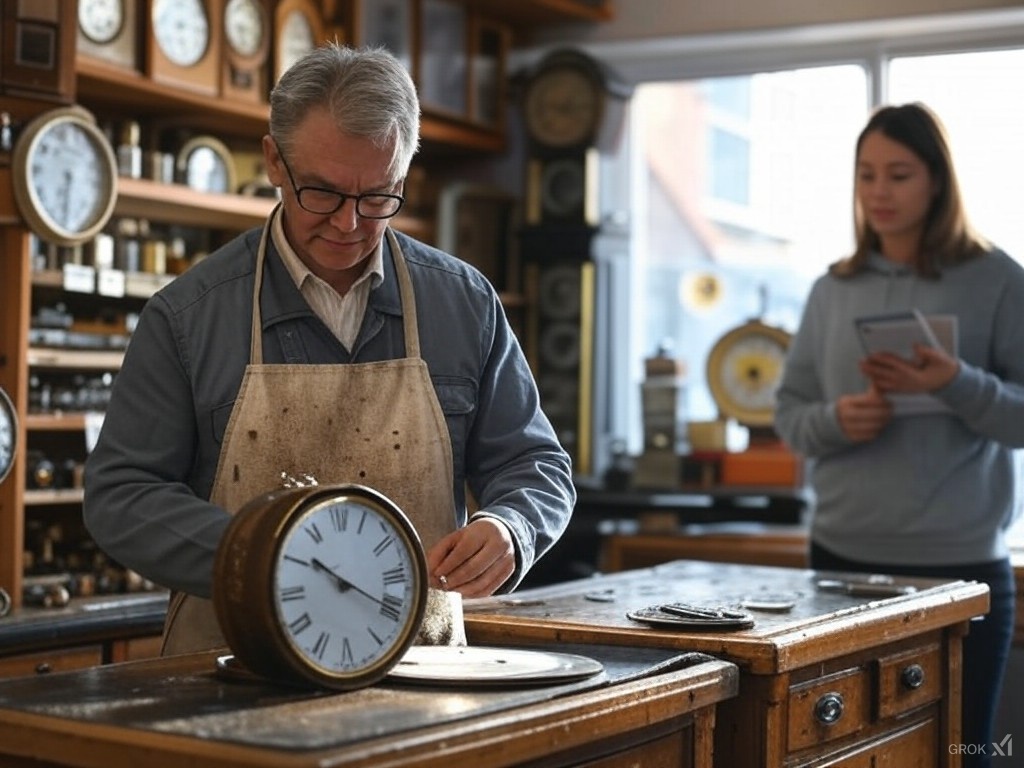
Charles lived in the village of Everwood, a place where the days seemed to move as slowly and steadily as the hands on his clocks. He wasn’t a farmer or a baker, like many others in the village. Charles was a clockmaker. His small workshop, nestled beside the old Birchwood Creek at the edge of town, was his world. It smelled of wood shavings, metal, and a hint of oil, and it was always filled with the soft, rhythmic tick-tock of countless clocks.
Inside the workshop, clocks of every size and shape lined the walls, sat on shelves, and stood tall in corners. There were small cuckoo clocks with their cheerful birds, elegant grandfather clocks that chimed the hours with deep, resonant notes, and pocket watches with tiny gears that Charles could see only with his special magnifying glass. Each clock was a piece of his heart, carefully made and lovingly cared for. Charles believed that every clock had its own story and personality.
He had a favorite, a tall, elegant grandfather clock that stood proudly by the front window. Its wooden case was a deep, rich mahogany, and its face was a pale ivory color with Roman numerals that looked like ancient secrets. Charles called it ‘The Sentinel’ because it seemed to watch over the workshop, ticking away the time with a solemn steadiness. This clock was the first he had ever built, and it was a masterpiece of his craft.
Every morning, Charles would wake with the first light of dawn and head straight to his workshop. He’d open the windows, letting in the fresh morning air, and then begin his work. The soft sounds of his tools were like a familiar melody—the gentle scraping of a file, the soft tap of a hammer, the precise click of tiny gears slotting into place. He loved the way the sunlight caught the brass and polished wood, making his workshop glow.
“Another day, another clock,” he would say to himself, his voice a soft murmur against the tick-tock background.
He wasn’t a man of many words. He was more comfortable in the company of gears and springs than with people. He preferred the steady rhythm of time to the hurried chatter of the marketplace. But Charles wasn’t lonely, not really. He had his clocks, and they were his friends.
One Tuesday morning, as the sun was painting the sky in shades of pink and orange, Charles heard an unusual sound outside his workshop—a car, something rarely seen in Everwood. The car parked by the Birchwood Creek, and a woman with a clipboard got out. She wore a smart tweed jacket and carried a large leather bag. Her name was Juliet, and she was a curator from the City Museum, a place Charles had only ever heard about.
Juliet walked up to Charles’s open door, peering inside. Her eyes widened at the sight of the clocks. “Goodness me!” she exclaimed, stepping inside. “I’ve never seen so many clocks in one place!”
Charles, surprised by her sudden appearance, wiped his hands on his apron. “Welcome,” he said, his voice a bit shaky. “I am Charles. I make clocks.”
Juliet introduced herself and explained that she had heard about Charles and his clocks from an old travel journal, which had mentioned a small workshop in a village called Everwood. She told Charles that she was fascinated by his craftsmanship and wanted to see his clocks in person.
“Your clocks,” Juliet said, her voice full of excitement, “they are truly extraordinary. I haven’t seen timepieces like these anywhere.” She pointed to The Sentinel. “This one, in particular, is remarkable. I’m certain it could be at the heart of our new exhibit on historical timekeeping.”
Charles, who had never thought of his clocks as anything more than simple time-telling devices, was taken aback. The idea of his clocks being displayed in a museum seemed almost impossible.
“A museum?” he asked, his eyebrows furrowing in surprise. “But…they’re just clocks.”
Juliet smiled. “Not just clocks, Charles. They’re works of art. They tell a story, a story of skill and time. They belong in a place where people can truly appreciate them.”
Charles hesitated. He didn’t like the thought of his clocks leaving his workshop, but he also wanted other people to see them. He wanted them to appreciate the beauty and the craft that he poured into each one. After a long moment, he agreed, but with a condition.
“I would like to install each one and ensure they are in perfect condition before they are displayed,” he insisted.
Juliet happily agreed.
The next few weeks were a whirlwind. Charles carefully packed his clocks, wrapped in soft cloths and placed in sturdy boxes. Juliet arranged for the transportation, and one sunny morning, a small truck arrived in Everwood to take the clocks to the City Museum. It felt strange to see the clocks go, to see his workshop becoming quieter. It was as if a part of him was leaving too.
When he arrived at the museum, it was a huge, grand building, with tall ceilings and marble floors. There were paintings on the walls and statues in the hallways. Charles had never seen such a place. Juliet showed him to the exhibit hall where he would install his clocks.
He carefully unpacked each clock and placed it in its spot. The Sentinel took pride of place in the center of the hall. With his tools, he made sure that every clock was ticking perfectly, its gears meshing smoothly. As he finished, he stepped back, looking at the display. The soft tick-tock of all his clocks together filled the hall, creating a comforting and unique sound, almost like the heartbeat of time itself.
The museum staff were astonished by his work. The other curators whispered among themselves about Charles’s skill and artistry.
The day the exhibit opened, Charles felt a mix of nervousness and pride. He stood in a corner, watching the people as they entered the hall. They walked slowly, looking at each clock with wonder and amazement. Charles saw families pointing at The Sentinel, whispering stories about their own clocks and memories.
A young girl, with pigtails and bright eyes, stared at the cuckoo clock, and when the little bird popped out, she clapped her hands with joy. An older gentleman, with kind wrinkles around his eyes, leaned close to a pocket watch, lost in thought about times gone by.
Charles smiled. He realized then that his clocks were not just telling time. They were connecting people with the past, sparking joy in the present, and maybe even inspiring dreams for the future.
From that day on, the clockmaker of Everwood became a known name, and his clocks became famous around the world. But Charles never forgot his small workshop in Everwood. He returned there every day, still making clocks, still listening to their steady rhythm, and remembering the way his quiet life had changed when a museum curator had knocked on his door.
Now, the steady tick-tock of his clocks echoed in grand museums and elegant homes, carrying the spirit of Everwood to faraway places. Each sound was a tribute to his craft—a gentle reminder that even from the smallest corners of the world, a legacy could grow. Charles’ work became timeless, touching hearts and inspiring dreams for generations to come.
About the Author