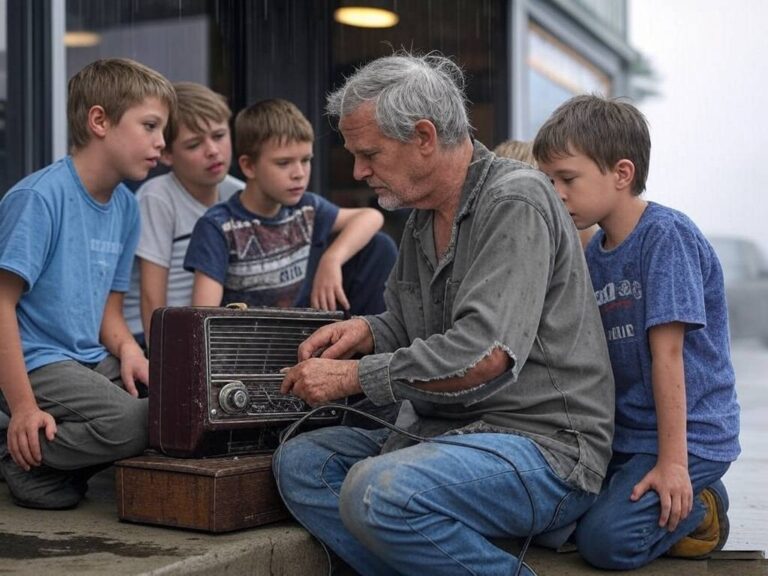
The old man, Elias, hunched over his chipped Formica table, the cafe’s fluorescent lights buzzing a sickly yellow above him. He stirred his coffee, the spoon clinking against the ceramic, a small, lonely sound in the cavernous, half-empty room. Outside, the rain hammered against the windows, a grey curtain drawn across the already grey city. He watched it fall, the city, not the rain, in his mind, and thought of the boy, Miguel, and the other kids, huddled under the leaky awning of the bodega, their faces tight with fear. The fear was a tangible thing, a cold breath in the back of his own throat.
Elias wasn’t a brave man. He wasn’t anything, really, in the eyes of the city. Just old Elias, who swept up at the fish market before dawn, the smell of brine and dead things clinging to him even after he’d showered and changed into his threadbare clothes. He kept to himself, a ghost in the bustling marketplace, a shadow flitting between the stalls. He had a small room above the laundromat, a single window looking out onto the brick wall of the next building. Not much of a view, but it was his.
He had something else too, something he kept hidden, tucked away like a faded photograph in a dusty album. He could fix things. Not just the broken hinges and wobbly chair legs that the fishmonger brought him. He could fix anything. Radios that crackled and died, toasters that refused to toast, clocks that ticked erratically, their hands spinning in a dizzying dance. He understood the intricate workings of things, the delicate balance of wires and gears, the silent language of mechanics. His hands, gnarled and calloused from years of hauling fish crates, were surprisingly deft, capable of the most delicate surgery on a broken circuit board.
But he never told anyone. He’d learned long ago, back in the small village where he’d grown up, that his talent was…unusual. The other boys had played football in the dusty streets, their laughter echoing through the narrow alleyways. Elias had stayed inside, fascinated by the intricate clockwork of his grandfather’s old watch. They’d called him *el raro*, the strange one. The name had stuck, a burr beneath his skin. He’d learned to hide it, to bury it deep beneath a veneer of ordinariness.
Now, the rain was coming down in sheets, and the radio in the bodega, the only source of news and comfort for the huddled families, had died. Miguel, a skinny kid with eyes too old for his years, had tried to fix it, his small hands fumbling with the wires, his face etched with worry. Elias had watched from across the street, his heart aching. He knew he could fix it. He could walk over there, take the radio in his hands, and bring it back to life. It would take minutes, maybe less.
But the fear, that old familiar fear, held him back. What if they laughed? What if they stared? What if they called him *el raro* again? He hadn’t heard that name in years, but the echo of it still vibrated in his bones. He could almost feel the weight of their judgment, the scorn in their eyes. He was too old, too insignificant, to suddenly become something else, something…useful.
He finished his coffee, the bitter taste clinging to his tongue. He needed another. He signaled the waitress, a tired woman with a name tag that read “Dolores.” She came over, her movements slow and deliberate. He ordered another coffee, black, no sugar. He watched her walk away, her hips swaying slightly beneath her worn uniform. She didn’t look at him, didn’t even acknowledge his presence. He was just another face in the crowd, another ghost in the city.
He looked back at the bodega. The kids were still there, their faces illuminated by the flickering light of a single candle. The rain showed no signs of stopping. He imagined them, huddled together, listening to the silence, the oppressive silence of a world without news, without music, without hope.
He thought of his grandfather’s watch, the intricate gears spinning in perfect harmony. He thought of the radios he’d brought back to life, the toasters that now browned bread golden, the clocks that ticked steadily, marking the passage of time. He thought of the satisfaction he felt, the quiet joy of understanding, of fixing, of making something whole again.
He thought of Miguel’s face, the worry etched into his young features. He thought of the other kids, their fear palpable in the damp air. He thought of the silence, the heavy, suffocating silence that had fallen over the bodega.
He stood up, the chair scraping against the tiled floor. Dolores looked at him, surprised. He pulled a few bills from his pocket, more than enough for the two coffees. He placed them on the table, nodded to Dolores, and walked out of the cafe.
The rain hit him in the face, cold and stinging. He didn’t care. He walked across the street, the distance seeming longer than it actually was. He stopped in front of the bodega, the awning dripping water onto the sidewalk. Miguel looked up, his eyes wide with surprise.
“Señor Elias?” he asked, his voice barely a whisper.
Elias nodded. He looked at the radio, a battered old transistor radio, its antenna bent at a precarious angle. He knelt down beside Miguel, the dampness seeping into his trousers.
“Let me see,” he said, his voice surprisingly steady.
He took the radio in his hands, his fingers tracing the contours of the plastic casing. He could feel the eyes of the other kids on him, curious, questioning. He didn’t look at them. He focused on the radio, on the intricate workings inside. He could hear the silence, the expectant silence of the children, the hushed whispers of the adults.
He opened the back of the radio, his fingers moving with a practiced ease that belied his nervousness. He saw the problem immediately, a loose connection, a simple fix. He pulled a small screwdriver from his pocket, a tool he always carried with him, a habit he’d developed over the years.
He worked quickly, efficiently, his movements precise and deliberate. He tightened the screw, checked the connection, and then, with a flick of his wrist, he turned the radio on.
A crackle, then a hiss, and then, a voice. A woman’s voice, speaking in Spanish, announcing the news. The kids gasped, their faces lighting up. Miguel smiled, a wide, genuine smile that reached his eyes.
Elias looked at them, at the children, at the adults, their faces no longer tight with fear, but softened with relief. He saw no judgment in their eyes, no scorn. He saw only gratitude.
He stood up, brushing the dirt off his trousers. He looked at Miguel, who was staring at him with admiration.
“It’s working now,” Elias said, his voice hoarse.
Miguel nodded, speechless. He reached out and touched Elias’s hand, a small, tentative gesture.
Elias felt a warmth spread through him, a feeling he hadn’t experienced in years. It wasn’t just the warmth of human contact, it was something more, something deeper. It was the feeling of being seen, of being accepted, of being valued.
He looked at the radio, the battered old transistor radio that he had brought back to life. He had fixed it, yes, but he had fixed something else too. He had fixed something inside himself.
He turned and walked away, the rain still falling, but now it didn’t seem so oppressive. He walked back to the cafe, the weight of the city, the weight of his own insecurity, lifting from his shoulders. He ordered another coffee, black, no sugar. He sat at his table, the fluorescent lights buzzing above him. He stirred his coffee, the spoon clinking against the ceramic. It was a small sound, but it wasn’t lonely anymore. It was the sound of a man who had finally found his place, a man who had finally found his voice. It was the sound of a man who was no longer afraid. He was still Elias, the old man who swept up at the fish market. But he was also something more. He was the man who could fix things. He was the man who had helped. He was, simply, Elias. And that, he realized, was enough.
About the Author